
A day after Chidambaram asked RBI to speed up the process of issuing new bank licences, Subbarao said last Friday that it would not be possible without fulfilling the enabling conditions for the same.
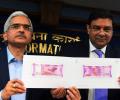
'When there is no middle ground possible between the government and the governor, the governor has to go.'

Former Banque de France head Jacques de Larosire was given the Lifetime Achievement Award for his lengthy struggle for monetary order, the magazine said in a statement on Monday.

State Bank of India, Tech Mahindra, Larsen & Toubro, Tata Steel, Sun Pharma, Infosys, HCL Tech, Axis Bank, Tata Consultancy Services and NTPC were among the biggest laggards among Sensex shares. Nestle, Hindustan Unilever, Titan, Power Grid, UltraTech Cement and ITC were among the gainers.

The comments assume importance as the traditional position of the central bank has been not to set a forex reserves target.

Deputy Governor Michael Patra warned about the spillover effects of food inflation.
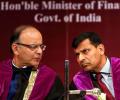
Finance Minister Arun Jaitley said in a Twitter post that the government appreciated all of Rajan's good work and respected his decision

'We are also conducting ongoing training and grooming at the branch level to pre-empt such cyberattacks.'
The Rajasthan high court has issued contempt notices to Reserve Bank of India Governor Y V Reddy and three State Bank of India officials for failing to comply with a court order.

Better protection for depositors and investors was one of the chief considerations in Union Finance Minister Nirmala Sitharaman introducing, on Friday, the Banking Laws (Amendment) Bill, 2024, in the Lok Sabha to amend four pieces of legislation. This amendment is also to improve audit quality in public-sector banks (PSBs), offer consistency in reporting by banks to the Reserve Bank of India (RBI), and provide for an increase in the tenure of directors in cooperative banks.
Concerned over the rise in mis-selling of products by banks and non-banking financial companies (NBFCs), the Reserve Bank of India (RBI) is examining whether to come up with norms to curb such practices. Observing that pushing financial products, such as insurance, indiscriminately to unaware consumers may be detrimental to their well-being, RBI Deputy Governor M Rajeshwar Rao said, "We are examining whether it necessitates framing of guidelines to address mis-selling of financial products and services by REs (regulated entities)."

A day after his appointment as the 26th governor of the Reserve Bank of India (RBI), outgoing Revenue Secretary Sanjay Malhotra on Tuesday said one must understand the economic landscape and do what was best for the economy. "Let me first go, join, understand the turf ... Here it is a different role," Malhotra said, speaking to reporters in front of North Block.

'That way you're not hostage just to US sort of exports to India.'

The famous 'tareekh pe tareekh' dialogue from the Hindi movie Damini captures where we are now.
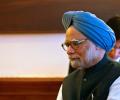
Former Prime Minister Manmohan Singh was a brilliant economist with a visionary outlook on India's potential, combined with a fine sense of political feasibility, former RBI Governor Raghuram Rajan said on Friday. Singh, the architect of India's economic reforms, passed away here late on Thursday at the age of 92.
The weakening of inflation, prospects of economic growth, geopolitical uncertainty and comfortable system liquidity may result in the Reserve Bank of India's (RBI) Monetary Policy Committee (MPC) to cut the repo rate by another 25 basis points, opine top economists. They also said the external economic pressures like trade policies and others would require continued RBI's accommodative stance and policy support for the Indian industry to sustain the growth.
RBI chief banks on 'significant measures' to battle a 'significant crisis'.
The government on Tuesday appointed three external members -- Ram Singh, Saugata Bhattacharya and Nagesh Kumar -- to the RBI's rate-setting Monetary Policy Committee for four years. The central government has reconstituted the Monetary Policy Committee (MPC) of RBI, the finance ministry said in a statement. Ram Singh is the director of the Delhi School of Economics, Saugata Bhattacharya is an economist, and Nagesh Kumar is the director and Chief Executive, Institute for Studies in Industrial Development, New Delhi.
Take the Rediff Biz Quiz and find out how much you know about the governors of the Reserve Bank of India.

The country's foreign exchange reserves declined by $7.541 billion to $572.712 billion in the week ended July 15 as the Reserve Bank continued to intervene in the market to curb the fall of the rupee. In the previous week ended July 8, the reserves shrunk by $8.06 billion to $580.25 billion, the Reserve Bank of India (RBI) data showed on Friday. On Friday, the rupee fell by 5 paise to close at 79.90 against the US dollar.

'If it doesn't, it will continue with measures to infuse liquidity, signalling a new cycle,' predicts Tamal Bandyopadhyay.

In fact, observers say ever since RBI moved to quarterly statements in 2005 during YV Reddy's term, the governor's life has become like that of a company chief executive -- both have to grapple with these quarterly statements, adding to the stress of an already hectic life.

'The government is putting insurance in the same category as food, which is essential for life.' 'Now this is an opportunity for the sector to focus on the consumer.'

The Reserve Bank of India's (RBI) Monetary Policy Committee's (MPC) decision to cut the repo rate by 50 basis points (bps) to 5.5% was contrary to the expectations of many economists. Firstly, most of the economists expected the MPC to cut the repo rate by 25 bps citing the weakening of inflation, prospects of economic growth, geopolitical uncertainty and comfortable system liquidity.
The probability of a global recession is low, even though the United States is growing slowly and Europe is experiencing negative growth, Reserve Bank of India Governor D Subbarao said on Friday.

'It's important for India to think about areas where it wants the US to move.' 'We can be far more innovative in what we ask the US.' 'Given that there's a package deal, why not do it?'

As per the RBI Act, the central bank has to have four deputy governors.

Commercial banks have turned cautious in lending to smaller microfinance institutions (MFIs), which has compelled the latter to borrow from non-banking financial companies (NBFCs) at much higher rates. Recently Reserve Bank of India (RBI) Deputy Governor M Rajeshwar Rao slammed micro lenders for increasing their margins "disproportionately" and said these lenders were quick to pass on the increased cost to the borrowers but reluctant to pass on the benefits under the new regime, where margins are not capped.
The Reserve Bank of India (RBI) has approved a three-member committee of directors to run the day-to-day functioning of cash-strapped Lakshmi Vilas Bank.

For the banking system a new cycle starts in FY2024. It's fraught with fresh challenges on asset quality and profitability, warns Tamal Bandyopadhyay.

Gandhi was the executive director at the Reserve Bank of India before being promoted to deputy governor post.
Reserve Bank of India Governor Y V Reddy has been awarded an honorary fellowship by the prestigious London School of Economics and Political Science for his contribution to the cause of the under-privileged.
While there are certainly more hawks perched on monetary policy committees of central banks around the world now than a couple of months ago, the doves still have the upper hand.

From CEOs to RBI governors, cricket's rich imagery and strategy resonate deeply with leadership, uncertainty, and decision-making across industries and global diplomacy, points out Suveen Sinha.

Interview with former Reserve Bank of India governor by Duvvuri Subbarao.

At a time when the role of corporate boards is once again under the scanner, independent directors on the Paytm Payments Bank board have indicated that red flags were raised over regulatory issues but they may have been late in doing so. "As independent directors, we asked questions and monitored responses to the Reserve Bank of India (RBI). Many changes were made on compliances. "Obviously, in retrospect, it was not found to be enough," said one of the independent directors on the condition of anonymity.

The small finance bank model may still be testing the water some 10 years since its launch. According to banking experts, the regulator has taken a cautious approach in granting approvals. Unity Small Finance Bank was the last one to get a licence in the category in November 2021.
